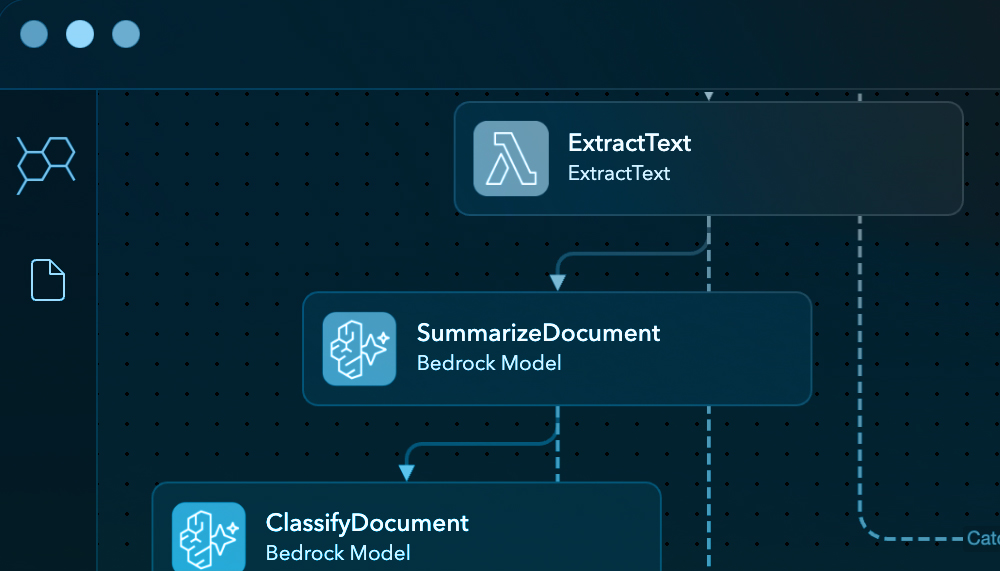
Amazon Bedrock gives developers access to a wide range of foundation models, all accessible through a unified AWS interface. When you combine these models with AWS Step Functions, you get a powerful way to build structured, repeatable AI workflows that can scale.
This article walks through the main Bedrock model providers available today, how they are used inside state machines, and how you can test everything locally without burning time and money in the cloud.
Why Bedrock and Step Functions Work So Well Together
Step Functions provide orchestration. You define how data flows, how decisions are made, and how errors are handled.
Bedrock provides intelligence. It generates text, creates embeddings, retrieves knowledge, and powers agents.
When you bring the two together, you can build workflows that are both controlled and adaptive. For example, you can validate input, call a model, branch based on the result, and then trigger additional actions such as storing results or notifying systems.
Anthropic Claude Models
Claude models are widely used for reasoning heavy workflows.
Available models
- Claude 3 Opus
- Claude 3 Sonnet
- Claude 3 Haiku
Where they shine
Claude is known for handling large documents and producing structured responses. It is a strong choice when your workflow needs reliable outputs that can be passed into downstream states.
Common Step Functions use cases
- Document processing pipelines
- Multi step reasoning workflows
- Chat and conversational flows
- Structured JSON generation
Amazon Titan Models
Titan models are built by AWS and integrate tightly with the rest of the platform.
Available models
- Titan Text
- Titan Embeddings
- Titan Image Generator
Where they shine
Titan models are efficient and predictable, making them a solid choice for production workloads that need consistency.
Common Step Functions use cases
- Embedding pipelines for search systems
- Content generation for internal tools
- Image generation workflows
- RAG pipelines using knowledge bases
Meta Llama Models
Llama models bring flexibility and strong developer oriented performance.
Available models
- Llama 2
- Llama 3
Where they shine
They are often used in workflows that involve coding, classification, or custom fine tuning strategies.
Common Step Functions use cases
- Code generation pipelines
- Classification and tagging systems
- Developer tooling workflows
- Custom AI pipelines
AI21 Jurassic Models
AI21 models focus on natural language generation.
Available models
- Jurassic 2 family
Where they shine
They are reliable for producing clean, readable text and summaries.
Common Step Functions use cases
- Content generation workflows
- Summarization pipelines
- Marketing automation
- Data to text transformations
Cohere Models
Cohere models are often used for search and ranking systems.
Start free. No AWS account needed.
ZERO AWS costs.
Download Thrubit and run your first state machine locally in under five minutes. No cloud setup, no IAM policies, no waiting.
Available models
- Command
- Embed
- Rerank
Where they shine
They excel at embeddings and ranking results, which are critical for search driven workflows.
Common Step Functions use cases
- Semantic search pipelines
- Recommendation systems
- Ranking and filtering workflows
- RAG optimization
Stability AI Models
Stability AI models focus on image generation.
Available models
Stable Diffusion variants
Where they shine
They are ideal for creative workflows that generate visual assets.
Common Step Functions use cases
- Marketing asset generation
- Automated design workflows
- Content production pipelines
- Image generation services
Mistral Models
Mistral models are efficient and cost effective.
Available models
- Mistral 7B
- Mixtral
Where they shine
They provide strong performance while keeping costs lower, which is useful for high volume workflows.
Common Step Functions use cases
- Real time processing pipelines
- Lightweight AI tasks
- High throughput systems
- Cost sensitive workflows
Bedrock Features Beyond Models
In addition to direct model access, Step Functions also supports higher level Bedrock integrations.
Supported integrations
- bedrock invokeModel
- bedrock retrieve
- bedrock retrieveAndGenerate
- bedrock applyGuardrail
- bedrock agent invokeAgent
What this enables
- Retrieval augmented generation workflows
- Knowledge base querying
- Agent driven automation
- Content moderation pipelines
These capabilities allow you to build complete AI systems without manually stitching together infrastructure.
Choosing the Right Model for Your Workflow
Each model serves a different purpose.
- Claude is best for reasoning and structured outputs
- Titan is ideal for AWS native scalability
- Llama and Mistral offer flexibility and efficiency
- Cohere excels in search and ranking
- AI21 is strong for content generation
- Stability AI powers image creation
Most real workflows combine multiple models across different steps.
Testing Bedrock Workflows Locally with Thrubit
One of the biggest challenges with AI workflows in Step Functions is iteration cost. Every test run in AWS can trigger multiple state transitions and model invocations.
Thrubit changes that by letting you run and debug your workflows locally.
With Thrubit you can run Step Functions locally with real Lambda execution. You can test Bedrock integrations, validate output paths, and simulate responses that match real model structures.
This means you can tweak prompts, adjust branching logic, and debug failures without deploying to AWS every time.
You get faster iteration, predictable development costs, and a much clearer view of how your workflow behaves before it reaches production.
Final Thoughts
Amazon Bedrock gives you access to a diverse set of AI models, and Step Functions gives you the structure to turn those models into real systems.
By combining them, you can build workflows that are intelligent, scalable, and maintainable.
And by testing locally with tools like Thrubit, you can build those workflows faster while avoiding the hidden costs that come with constant cloud iteration. Try our sample Bedrock workflows.