17 posts

What Is a Task State in AWS Step Functions?
AWS Step Functions help developers orchestrate workflows using state machines. At the center of most workflows is the Task state, the state type responsible for actually doing work. Whether you are invoking a Lambda function, sending a message to SQS, calling Amazon Bedrock, or publishing an EventBridge event, chances are you are using a Task […]
April 14, 2026
What Is a Parallel State in AWS Step Functions?
A Parallel State in AWS Step Functions allows multiple branches of a workflow to run at the same time instead of one after another. This is one of the most powerful features in Amazon States Language (ASL) because it helps developers: In simple terms, a Parallel State acts like a traffic controller that says: “Run […]
March 20, 2026
What Are Amazon Bedrock Inference Profiles and How to Set Them Up
Amazon Bedrock simplifies working with foundation models, but once you move into real applications, you run into challenges around cost, consistency, and control. That is where inference profiles become essential. They allow you to standardize how models are invoked across your systems, making it easier to manage behavior, swap models, and control costs without rewriting […]
March 12, 2026
What Is Amazon States Language in Plain English?
Amazon States Language, often shortened to ASL, is the JSON-based language used to define workflows in AWS Step Functions. If that sounds overly technical, think of it this way: Amazon States Language is simply a way to describe the steps your application should follow. It acts like a blueprint for automation. Instead of writing massive […]
February 11, 2026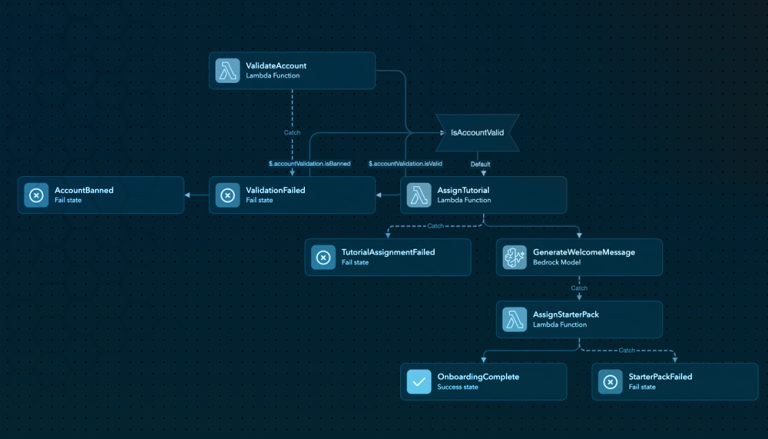
AWS Step Functions Examples Every Developer Should Understand
AWS Step Functions help developers orchestrate distributed systems, automate workflows, and coordinate cloud services without writing large amounts of custom orchestration code. Instead of building fragile logic inside applications, developers define workflows visually using state machines. From AI pipelines to payment processing, Step Functions are now widely used across startups, enterprises, SaaS platforms, fintech systems, […]
December 9, 2025